A Queer Quintet

A brief introduction: this is a book review round-up I wrote at the end of 2017, examining the five YA books with queer protagonists I’d read throughout the year. Not anything super in-depth, but I liked some of the similarities and contrasts I found between the books, and if you have been craving some queer lit, I have several recommendations in here for you. Happy reading!
The Players in A Queer Quintet: Ash, Lies We Tell Ourselves, Moon at Nine, Carry On, and Annie on My Mind.
Four with happy endings, and one very much without. Minor spoilers for denoting which ones have happy or unhappy endings.
(As a side note before we start, I highly recommend Lies We Tell Ourselves, Moon at Nine, and Annie on My Mind. Read Carry On if you love Rainbow Rowell or are starved for queer YA novels, and read Ash if you love Cinderella or are really, really, really starved for queer YA novels.)
Ash (Malinda Lo, 2009)
A lukewarm retelling of Cinderella, but with lesbians, which is an interesting premise, but it doesn’t quite deliver. There is a decent buildup of a romantic relationship between Ash and Li, but the Cinderella aspect detracts rather than adds to the story; you’re left wondering why, with everything that was changed from the original fairy tale, the author didn’t just ditch the glass slippers and write an original novel.
There’s a little hand-wringing over having taboo feelings for another girl, but not in any way that meaningfully impacts the story. Ash has a happy ending, which made me grudgingly like it a little more; lesbians with happy endings are that rare.
Lies We Tell Ourselves (Robin Talley, 2014)
I was very excited for this one, and it did not disappoint; I only wish there was more. Being queer can be dangerous enough in today’s world, but as a black girl during school integration in the 50s? “Deadly” barely covers it (don’t worry, that’s not a spoiler). The characters are excellently fleshed out, and you can almost taste the tension as Sarah and Linda try to fight their feelings, which could quite literally get them (or more likely Sarah and her family) killed. I really wanted their relationship to succeed, and was disgusted and heartbroken at the never-ending slog of racist taunts, threats, and actions Sarah and her peers have to endure on a daily basis. As empathetic as I am, there’s a huge difference between knowing intellectually that that kind of racism existed, and viewing it through the eyes of a real (fictional) person. It was a very good, startling reminder of my own privilege, which gave me a lot to think about.
Another happy ending, which astonished and delighted me. I would absolutely love to read a novel about adult Sarah and Linda’s relationship.
Moon at Nine (Deborah Ellis, 2014)
The diversity present in the small pool of queer YA books at my library was rather surprising; one featuring an African American protagonist, and another set in Iran. Two out of five ain’t bad (but it could be better). The history and culture of Iran is something I am very uninformed about, so on those points alone Moon at Nine was eye-opening and fascinating. To my pleasant surprise, the main characters, Farrin and Sadira, and their romance was endearing and well-written. This book is a little shorter and simpler (by which I mean written for the younger end of the YA audience) than the other entries here, but that doesn’t mean it shied away from the topics that naturally crop up when discussing lesbian relationships in 80s Iran.
On that note, be warned that this is the one without a happy ending.
Carry On (Rainbow Rowell, 2015)
This is the one that frustrated me the most, but that had more to do with the story structure, pacing, and general plot than the queer representation and execution. The problems surrounding the relationship between Simon and Baz didn’t help, however (long explanation short: this is an intentional ripoff of Harry Potter, but basically one where Drarry is canon. Also Draco is a vampire), especially the extremely meandering first half where there is a lot of setup and world building going on without much direction, which means the relationship is also moving in unsatisfying fits and starts.
Once again there’s some vague worrying about “what this means” (i.e., “I guess I’m gay?”), but it doesn’t amount to anything resembling conflict or consequences; it feels like the author ticked off the box marked “requisite Queer Angst.” Happy endings be here.
Annie on My Mind (Nancy Garden, 1982)
Without question, this is my favorite of the quintet, and also happened to be the one I read last. Additionally, it is the oldest of the five, first released in 1982, and has had the most impact on the YA scene. I’m not sure what to say, mostly because it’s just so well-done that discussing it would entail me praising every aspect of the writing, story, and characters. Just, read it.
And the final happy ending to round us out.
Thoughts
Overall, the portrayal of queer characters (which happens to be all lesbians with the exception of the Carry On couple) is positive; they are, by and large, written as people first, gay second. I found no glaring stereotypes or really any problematic aspects of the queer characters, which is good, but . . .
. . . But the stories here are not the only ones that exist in the gay community. Every single one of these books was of the “suddenly realizing I’m gay because I’ve fallen in love with someone” variety, and then dealing with that. Don’t get me wrong, this is not a bad thing by itself. This type of story is enjoyable and necessary to the lexicon of queer literature; it just isn’t the only one (yes, I’ve read Boy Meets Boy and Geography Club, both of which feature plots other than “discovering my gayness”; I just happened to read those in 2016 so am not discussing them here). I’m choosing to pick this bone because I think it’s a good reminder, even though I know these five books are not close to the only ones with queer characters and storylines. But it’s something to think about, which is really my only mission here; to analyze the stories we have and think about how we can make even better ones in the future.
Note that none of these five novels featured any trans, nonbinary, or any definitive, proud bi/pansexual characters—nor any aro/ace. I know books with this representation exist, but the fact that the most recommended and accessible books featuring LGBTQA characters were sorely missing at least three of its number is something else to think about.
Yes, “Cats” Has Value as a Film (Especially Now)

Believe it or not, I actually already had 95% of a Cats review written and ready to publish today, and I didn’t even know it was going to be released on streaming platforms tomorrow. When I learned this fact, it seemed like fate that today should be the day I talk about Cats. However, with the coronavirus already a much more closely felt, immediately impactful threat than it was even a week ago when I originally wrote this, I felt that perhaps some edits were necessary; the only thing that could cause more cognitive dissonance than talking about the coronavirus and the changes its brought would be to not talk about it. Which, strangely, makes it an absolutely perfect time for Cats.
I’ll admit up front that I’m not a huge Broadway nerd, or even a significant musical fan; I’ve seen Wicked, I adore Hamilton, and I had my obsessive Phantom of the Opera phase almost a decade ago, but that and some additional cursory knowledge is the extent of the context I had for Tom Hooper’s Andrew Lloyd Webber’s Cats. In November of 2019, I wouldn’t have been able to hum the melody of “Memory” or name even just one of the stupid, stupid characters from Cats. I am now, however, burdened with this and more knowledge, and shall share it with you. Knowing the context for the literal words in Cats is crucial—not because it will give you true understanding of the events in the film, but because then you know better than to try and suss out silly things like “metaphors” and “character arcs” and “story structure” during the hour and fifty minute runtime. (Trust me, there is so much else to focus on besides the confounding lyrics/dialogue.) In the late 1930s, renowned, Nobel-Prize-winning poet T.S. Eliot wrote a bunch of poems about cats and what their deal was in letters to his godchildren, and they were eventually collected and published into a cute, odd little children’s book. (They exist as an odd addendum to the rest of his non-cat-related catalog, and should not be taken as a taster for his broader style.) Flash forward to the late 70s, where composer Andrew Lloyd Webber took these poems that he’d loved as a child and set them to music, originally just as an exercise in matching music to lyrics, only for it to turn into a bizarrely enormous sensation. Unsurprisingly, the movie rights to the Broadway show were quickly snatched up by Universal Studios, who then took almost 40 goddamned years to actually make a movie version happen. Cats as we know it started production in December 2018, and wasn’t finished until the day before its release on December 20, 2019—except not actually, hang on, we’re sending a new version of Cats to theaters, it’s really finished this time, we pinkie promise.
Now for a tangent that is more relevant than it may appear to be: I recently got around to watching 2010’s Rubber, a long-awaited showing chosen by my lovely boyfriend, who dubbed it the dumbest movie he’d ever seen. Rubber, if you aren’t aware, is a low-budget, 80-minute film about a tire that gains sentience and starts killing people in a small desert town. I had heard of it, often in the context of “best bad movies” a la The Room and Birdemic. After watching it, however, Rubber didn’t quite reach the ridiculously enjoyable heights of something like The Room for me, particularly since a lot of the joy I got out of the film was that it was so well made (I’m not kidding: there are long, silent segments where the camera is centered on the tire, with no other subjects around, and director Quentin Dupieux is enviously good at using only sound and images to convey very clear feelings and intent. From a tire). But the reason I bring up Rubber is not because it was similar to my experience with Cats; quite the opposite. The real sticking point in Rubber not quite working for me as a “so bad it’s good” movie was its off-putting cynical tone. This tone wasn’t omnipresent throughout the movie (only with its semi-redundant human characters), but it was a strong enough presence that it left a bad taste in my mouth nonetheless. I found that this cynicism harkens back to the 90s and 90s media, where we all felt secure enough in life to heavily indulge in the sarcastic, the ironic, and the intentionally distasteful in our pop culture. This kind of media is not bad, and you are not bad if you enjoy it; I’ve just found that when I’m confronted with that 90s too-cool-to-care attitude, I automatically respond with the obvious rebuttal: if you don’t care, then why should I? But then—there’s Cats.
Months and months ago, when the trailer first dropped and we were all suffering from Cats fever—the only prescription for which is to walk into the ocean and never return—I noted that besides the, like, everything else about it, the oddest part of the Cats cats were that they still had human noses; why not change them to cat noses? Then the human-face-on-cat-head would belong roughly 40% less in the Uncanny Valley, and we could all get on with our lives. Unfortunately, I am not yet an award-winning script doctor for Big Hollywood, so nobody listened to me. And when I finally saw Cats in theaters, I was right; it was a bit distracting. But it is nothing, nothing, compared to the distraction that is just the movie itself; a sickening feast of constant color, noise, movement, or all three, where details, important characters, and vital plot points are treated with equal importance, and the normal three-act structure is traded in for an interminable series of events that progresses either too fast for the eye to properly process, or with the speed of a dying camel trying to crawl through quicksand during the longest day of the year. It’s an overwhelming riot of chaos that has to be seen to even attempt comprehension; and even then, good luck attempting to make sense of a film that doesn’t bother looking before it leaps from setpiece to setpiece, rolling in uncomfortable sensuality and gobsmacking lunacy.
But despite all of that—despite its failure on almost every level of filmmaking and storytelling, I still think that Cats has value, as both a film and an experience.
I know I frequently advocate financially supporting movies that perhaps don’t deserve it (*cough* The Snowman *cough*), but what Cats has over other, weaker movies is exactly what Rubber lacked: a completely sincere dedication to its own weird, weird heart. What often makes bad movies so fun to watch is the single-minded focus in vision that is so supremely confident in its own success that when it fails miserably, we all can’t help but laugh. I’ve laughed at other bad movies, sure—but I will never intentionally seek out films like Hobbs & Shaw, or Olympus Has Fallen, or Godzilla: King of the Monsters to watch again, because their failures are tiresome; just more mediocre, joyless content that Hollywood thinks audiences want. And we are going to continue getting Olympus Has Fallens and Hobbs & Shaws until all the lovably bizarre projects—like Cats—are profitable enough to encourage filmmakers to give us more of that good shit.
On a more serious note: infection and death rates, panic-hoarding, the impending election, and the isolation necessitated to keep everyone healthy all adds up to a very grim, panic-fueled atmosphere, which only gets worse when you spend time in the echo chamber that is the internet. It is vital to stay socially conscious, to stay calm, to keep yourself informed and with the proper perspective. Yes, all of these things are important, but as the inimitable Shirley Jackson once said, “No live organism can continue for long to exist sanely under conditions of absolute reality.” And what’s the perfect tonic to absolute reality? CATS! Get ready for: Academy Award-nominated actor Sir Ian McKellan lapping up a bowl of milk! Human-cockroach kicklines! Milk bars where female cats whine with desire for Jason Derulo-cat! Cats! Distractingly genital-less cats! MORE CATS!
“The Color out of Space” is Purple and it’s Perfect
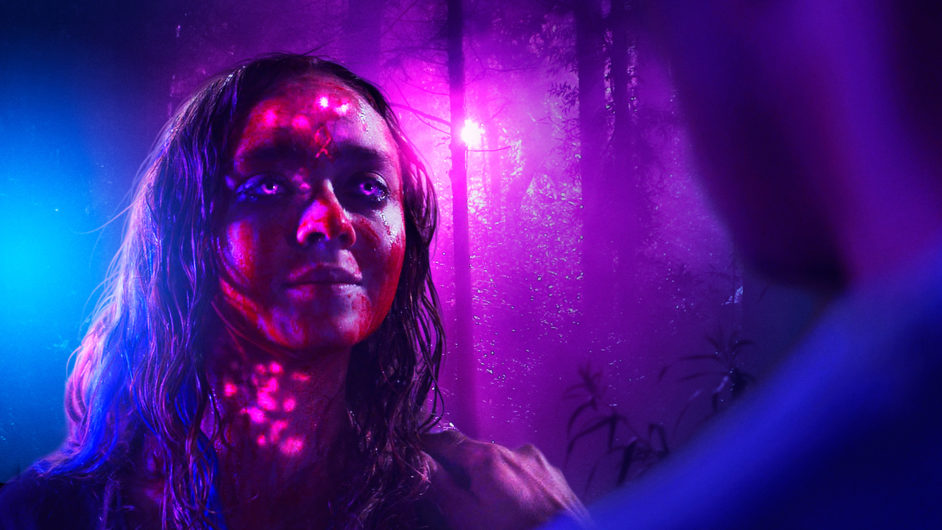
Let’s get one thing out of the way: the titular color out of space—intended in both the original story and vaguely mentioned in the movie to be indescribable, a hue humans cannot properly register and explain—is purple. Or, more accurately, shades of purple—from dark, menacing magenta to a violet so bright it almost hurts to look at. It’s a double-edged sword of the film medium, having to put to picture something that was intended to be created by and in a reader’s mind. However, in The Color out of Space, being able to put a name to that indescribable, mesmerizing, haunting color is not a disadvantage; you’re not worried about what the color is, but what it’s going to do. Because the color is not a static feature or even object in this Lovecraftian tale—it’s a force, a powerful force, with a strength alien and unknowable even as it seeps into your blood and takes hold of your mind.
A little background: The Color out of Space is a film adaptation of the 1927 short story by the Cthulhu creator and notorious racist himself, H.P. Lovecraft (side note: I don’t think it’s a coincidence that the stealth lead of this film, who also provides the opening and closing narration, is played by a black actor, Elliot Knight, who is excellent). TCooS did the film festival circuit in 2019, and received an extremely limited theatrical release before being released on Blu-ray/DVD and streaming platforms. My boyfriend and I had been keeping a close eye on the film ever since we saw the trailer in November 2019, and were very disappointed when there was only a single, one-night showing of the film in Milwaukee (which neither of us could attend). I bought the Blu-ray for his birthday, and we finally were able to watch it just yesterday—and by God, was it worth the wait.
The story focuses on a family of five—mother and father, two sons and a daughter—having semi-recently started their lives afresh on an isolated farm after the mother went through cancer treatments. They quickly encounter Ward, played by the aforementioned Elliot Knight, a hydrologist who becomes concerned with the water the family heedlessly consumes after a mysterious meteorite lands in their yard. Before you even start the movie, however, a certain expectation has been set—the poster, DVD cover, and trailer prominently feature Nicolas Cage, and this primes the audience to be ready for some quality, grade-A Nic Cage freakouts. The film definitely delivers, but what excited me more was less when Nic Cage was onscreen and more how he was used onscreen. Due to his enthusiasm in embracing his own meme quality, Cage can be tremendous amounts of fun in bad movies, but only up to a certain point. The best performances will wilt if they’re not supported by the story, script, surroundings, and other actors. Here, director Richard Stanely—who also wrote the screenplay with Scarlett Amaris—finds the sweet spot by balancing a very volatile element with a lot of potential—Nic Cage—with all of the other wonderful elements contained in The Color out of Space.
What The Color out of Space gets right that so many other Lovecraft film adaptations failed to do has little to do with the cosmic horrors, or the visuals (though TCooS does well with both), but with balance and pacing. There aren’t any wasted scenes in this film, no superfluous lines of dialogue, no plot cul-de-sacs or unnecessary diversions; but then when—to use a technical term—shit gets fucky, little is spared in creating a beautiful spectrum of terror, from delusions and hallucinations to gritty body horror, all set against a tense, moody score (reminiscent of the Uncut Gems score, all synthesizers and spacey sounds) and vivid, gorgeous visuals.
The film isn’t perfect (some of the setup is established in a blur with throwaway lines, the older brother doesn’t really get a character arc like his siblings, and my excitement over seeing Indigenous actress Q’orianka Kilcher on the cast list was diminished when she only appears briefly in three scenes), but these nitpicks are just slight distractions from the magnificent piece of art that is The Color out of Space. The film does so much right, showing restraint to make its punches hit all the harder, not being afraid to include humor amidst the horror, the spiritual and practical homage to Carpenter’s The Thing, the bizarrely wonderful and appropriate Trump impression Cage pulls out at strategic times. The film also acts as a triumphant comeback for director Richard Stanley, who had not directed a feature film since he was fired from his dream project, The Island of Dr. Moreau, in 1996. The Island of Dr. Moreau (which I watched as a teenager, deep in my Val Kilmer phase) was an absolute nightmare to make, for cast and crew, both before and after Stanley was fired (it’s a fascinating tale, and if you’re interested in cursed productions, check out the appropriately named documentary Lost Soul: The Doomed Journey of Richard Stanley’s Island of Dr. Moreau).
And with that, I arrive at a call to action; during promotion for The Color out of Space, Richard Stanley revealed that he wanted to make a whole trilogy of Lovecraft-inspired films, with TCooS being the first, then, God willing, followed up by one of Lovecraft’s most famous stories, The Dunwich Horror. Because TCooS was not given a wide release, the only way to support Stanley’s vision is by word-of-mouth, and buying/renting The Color out of Space. The prospect of another visceral, visually stunning feast of a Lovecraft movie is something to get very excited about, especially with Richard Stanley at the helm. Lovecraft’s works are public domain, so Stanley doesn’t have to deal with pressure from a studio that is very precious about its intellectual property, the way DC films have slashed and reshot entire movies trying to build a franchise (which, granted, they seem to have finally given up on), or how Marvel keeps its movies firmly within the safe, easily digestible formula audiences are used to. So, please, if you have any interest in The Color out of Space, definitely rent or buy it—it’s available on DVD and Blu-ray, and streaming to rent or buy on Amazon, YouTube, Google Play, and Vudu. The Color out of Space is very much a movie I crave after watching something mediocre (like last week’s In the Tall Grass)—it’s fresh, fun, fascinating, and most importantly—purple.
The Exploitative Horror of “In the Tall Grass”
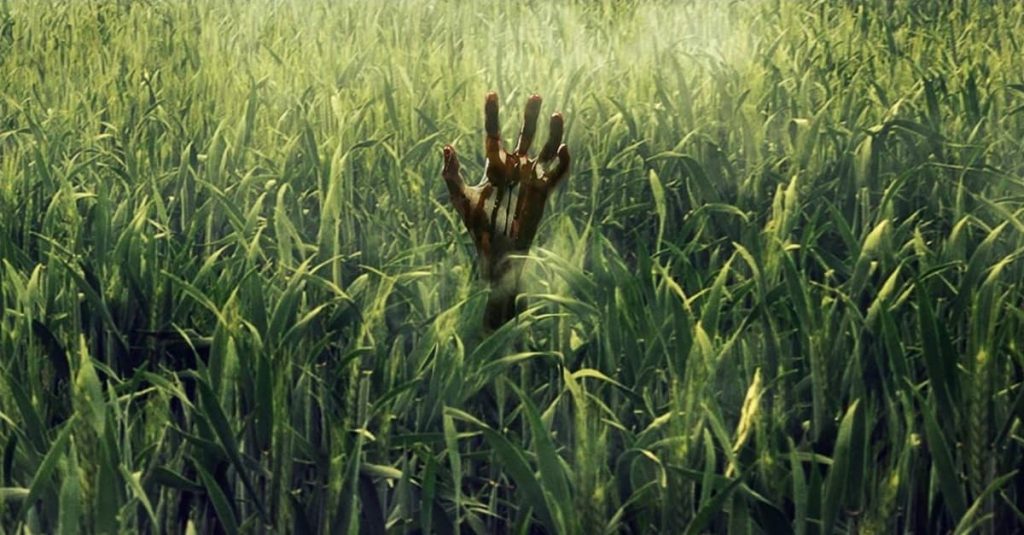
The premise for this movie (based on a novella by Stephen King and his son Joe Hill) is so exciting—we enter the grass very quickly, with only about ten minutes of establishing our main characters, siblings Becky and Cal. Hearing a child cry for help from within a vast field is such a good hook, especially when the second voice chimes in, screaming at the child to stop calling people into the grass, don’t come into the grass. It’s so creepy and foreboding, and I liked how Becky displayed an almost unconscious wariness of the grass; while her brother is about to jovially stroll in, confident he can help, she hangs back and her hand drifts towards her stomach (she’s six months pregnant), staring at the innocuous-looking grass and obviously feeling uncomfortable. Of course, both she and Cal go into the grass, because we were promised a movie.
I love the initial elements present in In the Tall Grass; how the grass separates them immediately; how sounds in the grass are always moving (Cal hears Becky from ahead of him, but then when she calls next, suddenly her voice is behind him, and much fainter). The claustrophobic nature of the grass itself is an excellent mood-setter, a seemingly banal jungle that becomes more and more sinister as the film progresses. It’s an easily understandable, effectively scary premise, and I was excited to watch the characters figure out The Rules (for there are always Rules, and to defeat the horror you must figure out The Rules). I was excited by all the potential ItTG was offering me. Then—all the other shit came in.
The problems plaguing ItTG can be summed up in two words: logical consistency. ItTG plays with so many concepts—some of them interesting, some weird, and some unpleasant—but it refuses to find a middle ground where its ideas are consistent (tonally and plot-wise) enough to make sense, but also clever enough that it’s not immediately obvious what’s going on. Some mysterious aspects of the grass are explained and de-mystified to the point of becoming boring, while other aspects are only paid lip service to. Instead of utilizing Rules to escape the grass, the characters leap to bizarre conclusions that somehow work, as the film’s logic bends to allow whatever it wants. It’s similar to a phenomenon I find very irritating in detective novels, where near the end of the book the detective identifies the culprit based on crucial information that the reader was never privy to. Look, a mystery novel technically doesn’t have to be written so the reader can solve it, but it’s a hell of a lot more fun if it is. The logic of the ancient rock and death in the grass doesn’t have to work consistently, but it’ll be way more satisfying to see our heroes defy the grass through a loophole or clever solution if it does.
To be completely honest, the main reason I found myself disliking In the Tall Grass so much basically came down to one scene, late in the movie. (This will serve as a spoiler and a content warning; skip to the next paragraph if you don’t want or need either of those.) Becky is six months pregnant at the start of the movie, and there’s an odd subplot involving her unborn baby and the big ancient rock that seemingly controls the grass; she keeps having visions involving her baby, blood, the rock, and the grass. These are unnerving, but for the most part don’t really amount to anything, except for the most upsetting scene in the movie: in the third act, Becky starts going through labor, and delivers her baby in the mud and the grass while a huge thunderstorm crashes above, the ancient rock looming and seemingly observing. It’s very tense, and adds an urgency to Becky and Cal’s quest to get out of the grass. Becky passes out from the strain, and when she wakes up, it’s to her brother Cal (who has touched the rock and thus been infected with its madness) feeding her bites of food. Exhausted and hungry, she eats what he gives her, while the viewer experiences mounting feelings of dread. Eventually, she asks what she’s eating, starting to panic, and Cal laughs and says it’s only grass—the leaves, the stems, the seeds. Becky asks to hold her baby. Cal says she can’t right now. From the little glimpses we see, it’s obvious he isn’t feeding her grass, and the viewer’s dreadful fear is confirmed. Now, this is not some sacred ground no director or writer has ever dared to touch; Snowpiercer and The Road both feature a scene of this sort. Except in those films, it’s an example of humanity at its lowest, committing one of the most taboo acts in order to survive, and there’s some exploration of the psychological toll this takes on the characters. This is not present in In the Tall Grass; it feels like more of a shocking scare for the sake of a scare, and I was surprised at how much this scene repulsed me. Everybody’s mileage will vary, obviously, and for me I think this useless, grotesque scene reminded me of the kind of horror I hate; the needlessly exploitative, the kind without style or substance—the laziest type of horror that isn’t used to explore any themes or relieve a cultural worry, but just exists because it will get a reaction.
(The spoilers end here.) But as I intimated, brutal horror is not inherently bad or worthless. One of my favorite Stephen King books is The Long Walk, one of several he published under a pseudonym—Richard Bachman—in the 1980s. King’s writing as Bachman tended to be darker; a little angrier and a little more cynical, which usually isn’t my style; but there was something about the brutality of these books that I was drawn to. In The Long Walk, set in a vaguely dystopian future, 100 boys sign up for the Long Walk every year, an event where the boys—walk. The last one standing gets an “unimaginable prize” (we can infer it’s insane amounts of money). As you could maybe assume, the entire book is just the boys walking, getting to know each other, their number getting smaller and smaller as the exertion starts taking its toll on the other walkers. It’s like if Waiting for Godot was made into an exploitation film, and I really, really love it. The difference between my love of the brutal horror in The Long Walk versus In the Tall Grass relates to a very common problem King has in his writing, which is this: reading The Long Walk I, ironically, felt like King invited me for a walk (hey here’s a cool premise, wanna hear about it?), and we’re leisurely strolling along, making steady progress along an interesting route, knowing that when we stop and rest it will be very satisfying, a reward for the effort we put in. When watching In the Tall Grass, there is the same invitation (hey look at this trailer, pretty neat huh?), but then Stephen King kidnaps me, straps me into a rollercoaster, and as the coaster rides up, down, and along the crazy rails, he monologues his extensive and complex manifesto at me, while I sit there, confused, angry, and not a little sick.
When I reflect on The Long Walk, I think about the worth and expendability of human life, of that unpleasant but irresistible desire to look closely at that car wreck, that crime scene, that dead body. When I reflect on In the Tall Grass, I think about some very cool ideas that, instead of showing me a new perspective or inspiring new avenues of thought, just left me uncomfortable and unhappy.
Beyond the Rage: Themes in 28 Days Later
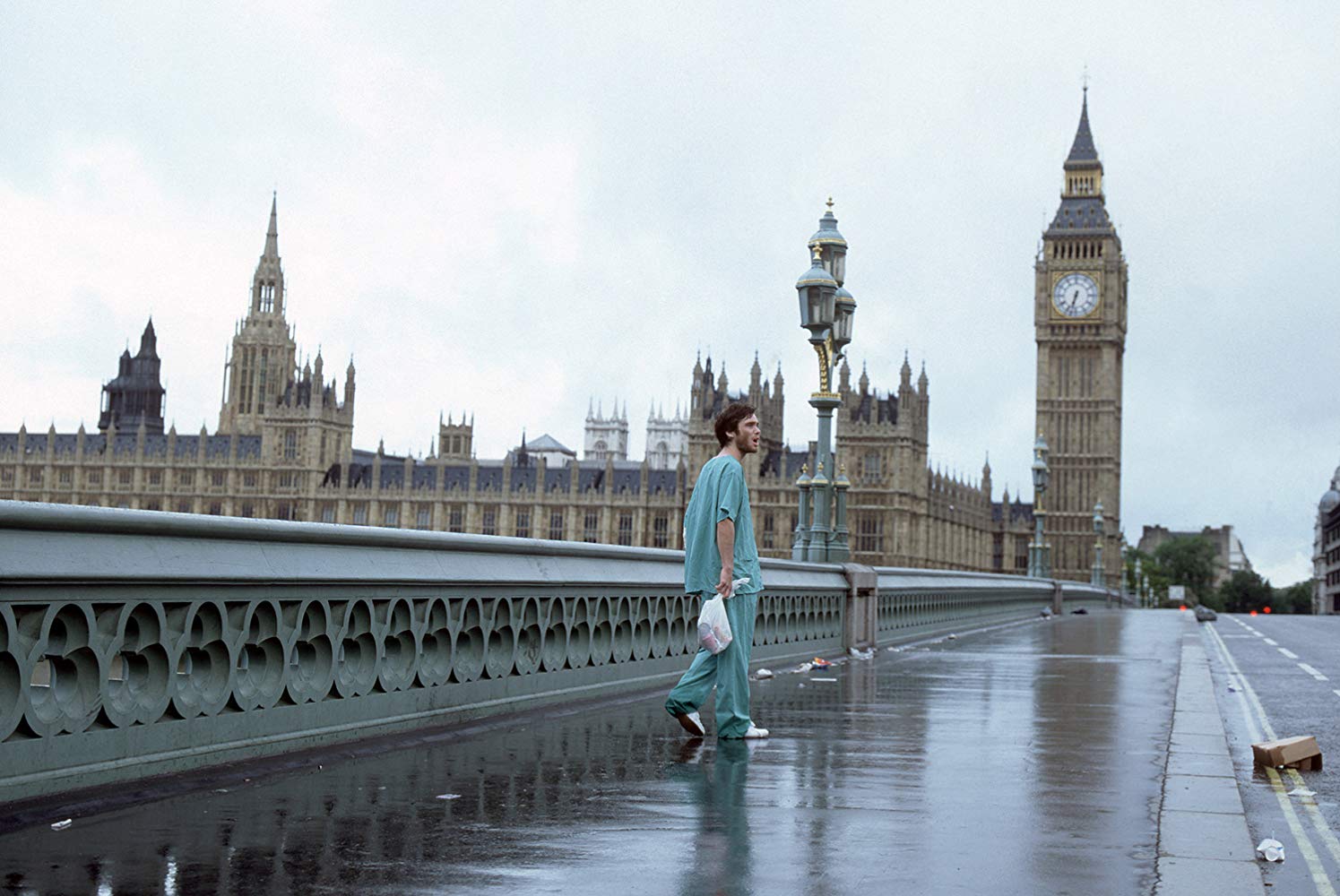
There is a moment in the 2002 film 28 Days Later where the main character Jim, who recently arrived at an army base with his friends seeking sanctuary and a cure from the rage virus, is told by Major Henry West, “I promised them women.” “Them” being the nine remaining soldiers he has at his command, West goes on to tell Jim that he had prevented one of the nine from taking his own life just a week ago; the soldier had been despondent at the ever-decreasing odds of life ever becoming normal or good again, when people with the rage virus were still swarming outside their heavily defended encampment and the entire city of Manchester, devoid of its pillars of infrastructure, was an endlessly burning pile of rubble. Major West tells Jim, “I promised them women,” meaning that, as he puts it, the only way to keep his soldier’s fragile stability and control in check was with the promise of new life—a rebuilding of society, a chance to once again feel secure and content. The Major’s magnanimous words ring rather hollow, however, when he allows his soldiers to begin sexually harassing and assaulting Jim’s friends, Selena and Hannah, the latter of which is only fifteen years old.
“I promised them women” is the single scariest moment for me in all of 28 Days Later, a film which is not without its fair share of somewhat standard frights; from sudden, silent attacks from swarms of infected people, to more existential horrors, like being faced with a child infected with the virus, relentlessly trying to harm and thus infect you, with the only choices presented being: succumb to infection, or kill this child. “I promised them women” is the tipping point of the film, where the tension that has been steadily ramping up in intensity for 60-plus minutes suddenly shatters with a terrible, inevitable finality; the quiet, steady notes of the best piece of scoring from the film, “In the House, In a Heartbeat,” starts to play, a reference to a statement from Selena to Jim, early in the film; paraphrased: if you become infected, I will kill you in a heartbeat. In the ensuing 30~ minutes, we see all the themes director Danny Boyle and writer Alex Garland have been laying the foundation for spotlighted against the unnervingly constant two-note pattern that begins in “In the House, In a Heartbeat”; themes of masculinity, and the importance of human connection and empathy.
The most obvious theme that plays throughout 28 Days Later is of friendship, love, and family—the important aspects of what bonds humans together. Jim wakes up after the rage virus has already swept throughout the country, naked and alone in a hospital room, the picture of vulnerability. He’s not only eager to join up with other survivors, but needs to in order to survive, a fact Jim never seems embarrassed or emasculated by. Father-daughter pair Frank and Hannah feel similarly to Jim, that there’s safety in numbers; the only exception is Selena, who we see murder her partner-in-survival, Mark, without hesitation after he’s bitten by the infected, just ten minutes after we’re introduced to her. Just after this brutal scene is when Selena tells Jim that she’d kill him in a heartbeat if he became infected, because the absolute top priority is staying alive—not saving people, not looking out for anybody else, just surviving. It would be very, very easy to have had Selena fall into a “badass bitch” stereotype, but it barely takes any time before we’re shown that Selena is far from heartless. As they travel together, Selena can tell Jim is struggling, but he doesn’t tell her he has a headache until she directly asks what’s wrong with him. When Selena asks why he didn’t mention it earlier, Jim bluntly states that he knew she wouldn’t care. Selena pauses for a brief but very telling moment before she pulls out some painkillers and tells Jim, in an almost gentle voice, how they can fix it. Selena’s tone is important because it lets us know that she isn’t offended by Jim’s assumption, just surprised; one could interpret that she regrets coming off as uncaring or cruel, and so makes an effort to adjust that. Seconds later, however, the pair are forced to suddenly sprint up several flights of stairs as the infected come for them, and Selena doesn’t slow down or even turn as Jim, who falls a floor or two behind almost immediately, desperately calls after her to wait for him. Several scenes later, after meeting Frank and Hannah, Selena warns Jim that the pair would just slow them down, and could get them killed. For that one moment of softness from Selena, it’s immediately followed up by two more instances of her singular and, one could argue, selfish mindset of survival. It’s a back-and-forth game that Selena plays throughout the entire movie, though by the end, when Selena is literally throwing herself between Hannah and the soldiers, it’s clear that she has given up her unforgiving “go it alone or die” attitude.
Selena never shows the same hesitation towards necessary violence that plagues Jim throughout the film—until almost the very last moment, when she’s confronted by a blood-drenched Jim, and halts her instincts screaming at her to kill kill he’s infected kill him. With Selena’s machete hovering just scant inches away from his neck, Jim says, tone suffused with both relief and sass, “That was longer than a heartbeat.” This is a culmination point for both characters: Jim standing strong and resolute in the decisions he’s made on his own, and Selena letting her humanity respond before her survival instinct does.
On the topic of masculinity: it doesn’t feel like accidental casting that Jim is played by Cillian Murphy, a somewhat odd-looking yet beautifully striking-looking man, whose slight build and musical accent puts viewers in mind of (and I hate to use this phrase) a “beta male” protagonist. Not somebody like Dwayne Johnson, whose enormous build backs up the easy-going confidence he often portrays onscreen, or even a leading man like Robert Downey Jr., whose quick sharp wit backs up a different kind of confidence that often results in cutting down those in front of him. Murphy’s Jim starts the film as vulnerable as possible, and is saved multiple times in the film by Selena and Frank. He knows nothing about the changes to the world, having been in a coma for the past 28 days, and frequently fucks up, forgetting the new rules he has to follow in order to survive. When he suggests checking out an apartment building with flashing lights to Selena, it isn’t with a tone of aggression or any kind of self-consciousness; just a calm, logical, and optimistic thought process. Jim’s defiance of the typical leading male character archetypes becomes much more obvious once he, Selena, and Hannah arrive at the makeshift army base; he stands in stark contrast to the Major and his soldiers, who by and large are loud, jeering, and full of restless machismo energy, which is demonstrated almost immediately after the group arrives, and some of the soldiers commandeer the Jeep(?) the group had been driving, doing doughnuts outside the fortified walls whilst hanging off the sides of the car, screaming and laughing. Jim is quiet in the face of all this—quieter than usual, as their arrival was immediately preceded by the awful and heart wrenching death of Frank, whom Jim had to kill himself—and responds with mostly bemusement at the Major’s aggressively dominatingly masculine words and actions. The Major immediately separates Jim from Selena and Hannah, assuming that Jim is the de facto leader, and ribs Jim about traveling with Those Women, to which Jim responds noncommittally. This is when the Major has the “I promised them women,” conversation with Jim, who seems too shocked to raise much protest, not that the Major seems to expect (or allow) any. After the Major finishes telling Jim that his friends are to be subjected to non-consensual sexual assault—for the sake of morale, you see—he leaves Jim with a fondly-delivered pet name and a hand ruffling his hair. Besides seeming vaguely irritated by the condescending treatment, Jim is at a loss of what to do, besides warning Selena and Hannah and getting all of them out of the reach of the Major and his soldiers. He doesn’t run back into the Major’s office, guns blazing, ready to mow him and his soldiers down; rather his instinct is to run, now. Unfortunately it’s too late, and Jim is escorted outside the fortress by two of the soldiers to be executed, along with another soldier who had the gall to object to Selena and Hannah being raped. Here, though, is the beginning of Jim’s rise: he manages to trick the soldiers, playing dead among the row of Infected bodies and leaving his ripped shirt on the barbed wire fence to suggest he escaped. Thunder booms loud and close as the climax of the third act begins, and we soon find Jim back at the fortress, shirtless and rain-soaked, almost totally silent as he begins to take out the soldiers, one by one. The old building and disorienting lightning flashes make Jim’s actions seem like that of a ghost, as the dwindling group of soldiers spread out to try and find him, jumping at shadows and swinging their rifles around to no avail. In these scenes are some of the most brutal acts of violence, as Jim unleashes the chained-up Infected soldier into the building to wreak havoc, and pushes his thumbs into the eye sockets of a soldier he’s fighting (a scene I have, with every single viewing, had to close my eyes at). During this entire lethal massacre, where he’s flitting from dark corner to shadowed hallway, Jim says nothing, his entire being silent—right up til Selena almost murders him, not sure if her blood-soaked friend is Infected.
In a different, more cynical reading, one could probably follow all the points I’ve laid out and complain that Jim’s progression from healthily scared, frozen prey to bloodied brutal predator is a cliched realization of the oft-used trope “underdog protagonist turns into improbably slick killing machine,” but I find 28 Days Later to be one of a few films that uses that trope correctly, by effectively establishing Jim’s abilities and fears, and slowly having him forced to confront and struggle through his barriers. Director Danny Boyle has, to great effect, established the power and lethality of absolute silence, with at least two scenes where we witness Infected sprinting rapidly yet soundlessly towards prey, only making noise as they burst through glass or clamp onto their target—and in both of those scenes, Jim was the target. The third time we see this action, it’s from Jim, turning the attacks he had suffered into a tool to make his enemies suffer. Jim’s strength in the third act is also not one of unbelievable, previously unseen muscle power, abilities, or weapons training, but of using skills he’d been forced to learn since he’d woken up alone in the hospital. And when Jim is shot, it’s not because he froze in a moment of choice paralysis, but simply because somebody else had the upper hand in the form of surprise. In the end coda, we can see that Jim has still retained his good humor, and hasn’t undergone a grimdark character overhaul; he’s still surviving, but finally thriving as well.
28 Days Later is far more interesting than it needed to be, and its relatable, engaging characters, interesting themes, and singular style are what sets it apart from more generic, throw-away zombie thrillers. What I like most about 28 Days Later is the subtlety of its strengths; while we’re with Jim and his point of view from the start of the film, Selena is arguably the co-lead of the film, and I love her so much. While she isn’t defined by her femininity, she also doesn’t reject it in order to appear more capable or serious; she’s cunning, assertive, can laugh and joke while still being focused, and she’s a natural badass without being cold-hearted. To wrap up, I highly recommend 28 Days Later, both as a character study and as a scary thriller. I even recommend its not-great-but-pretty-good sequel, 28 Weeks Later, and, God willing, you’ll hear from me the second a 28 Months Later gets made. It’s been thirteen years, sure, but it could happen. And I’ll be first in line to see it.
This didn’t fit into the essay, since I mostly focused on Selena and Jim, but I wanted to include it here because I love this scene so much:
One of the more touching moments in the film comes when, after a surprisingly pleasant scene wherein the gang raids a supermarket and come away with preservative-fresh apples (“Mmmm, radioactive,” Frank jokes), chocolate, and fine whisky, the four sleep in an open field. Finding difficulty in relaxing enough to sleep, Hannah and Jim take some of Selena’s Valium, with only Frank refusing. We then fall into a nightmare Jim is having, where he wakes up in the field completely alone, his friends gone, with no sign of them ever existing. In the dream, Jim is essentially re-enacting his first scene from the movie, only this time he’s screaming out his friend’s names, visibly distraught. Cutting back to the real world, we see Jim twitching and muttering in his drug-induced sleep, and Frank, still awake on watch, quietly nudges the younger man awake (“Jim, wake up—it’s only a dream, it’s alright, you’re alright.”). Jim rouses at Frank’s voice, half-asleep but no longer in the nightmare, and before he slips back under he murmurs, “Thanks, Dad.” Jim is asleep again instantly, but the scene holds for a few moments more, and we see Frank freeze at Jim’s words before quietly retreating back to his post. It’s a well-done moment, emphasizing Jim’s current state of mind and Frank’s role as Group Dad.
“Devil’s Knot” Cannot Untangle Itself
Times watched: first time
Method: streaming
Was released in: 2013
Wow, it sure did not take long for my other personal interests to intersect with my movie reviews. Before we start, content warning for very brief mentions of murder. Now: in short: I think making a movie out of the 1993 West Memphis Three case was a mistake, especially in the way it was done.
In longer: In West Memphis, Arkansas in 1993 three boys were horrifically murdered and brutalized. Shortly after, three then-teenagers—who became known as the “West Memphis Three”—were arrested and later convicted for the crime, with one of the teens receiving the death penalty. It was an extremely horrific, messy case that happened right at the tail end of the “Satanic Panic,” just a few years after the infamous McMartin preschool trials had finally ended; before the West Memphis murders, many thought the hysterical, overblown fears about ritual abuse and Satan-worshipping teenagers were finally over. Unfortunately, the West Memphis 3 case prolonged the Satanic Panic for years.
There are so many details in the WM3 case: statements, retractions, trial records, witness testimonies, recantations of witness testimonies, junk science, actual science, re-testing of original evidence, paperwork trails, new interviews of old witnesses, and endless appeals. It’s way too much information to try and give even a basic overview within the format of a two-hour dramatic film, and yet Devil’s Knot tries, despite the existence of the three-part documentary Paradise Lost, which is far more comprehensive and delivers the full story without taking any creative liberties, as well as the book Devil’s Knot, from where the film gets its name, by Mara Leveritt (if you’re interested in this case, I highly recommend both the book and documentary more than this movie).
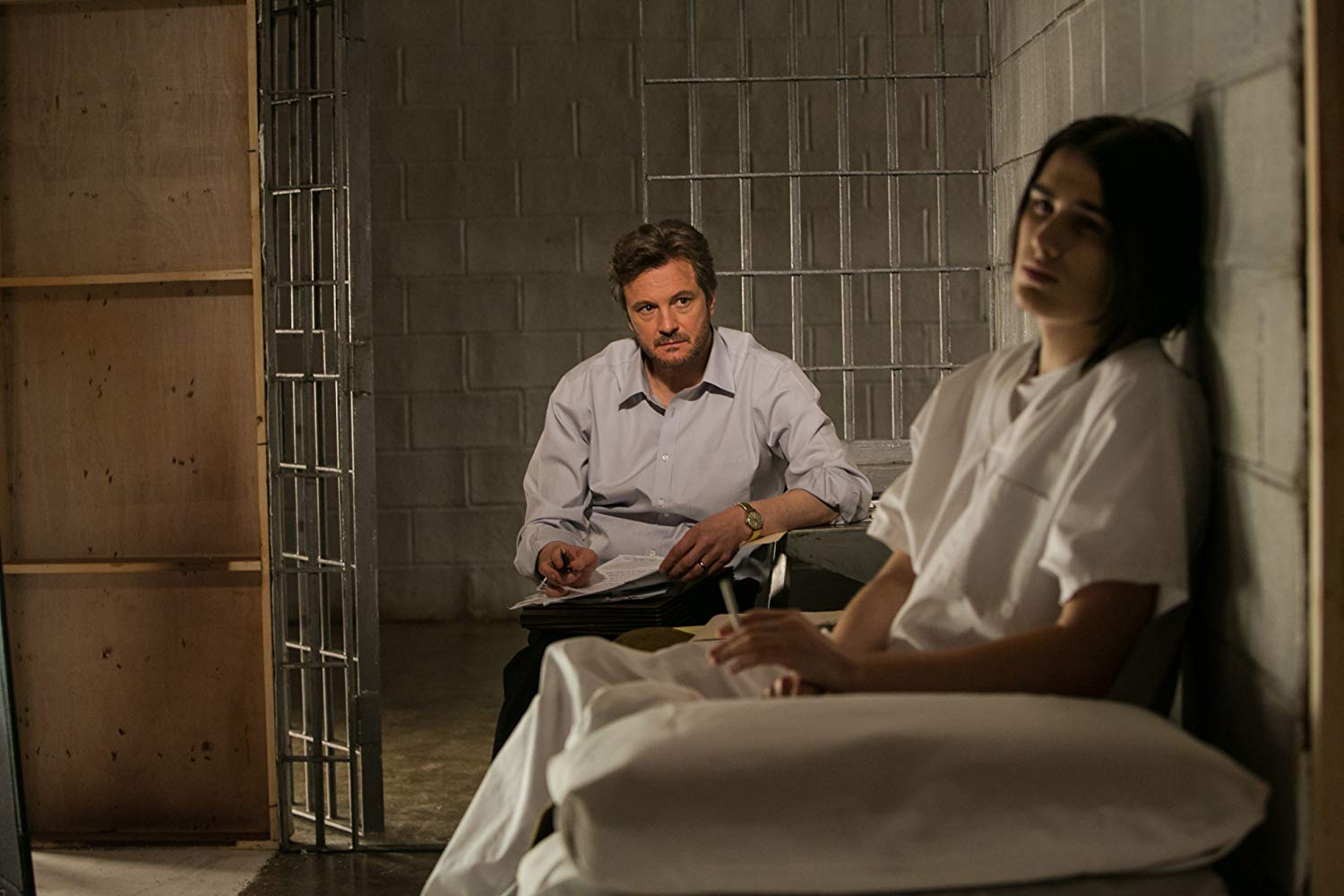
Devil’s Knot makes a valiant attempt to stuff the entire story in two hours of runtime by using every form of storytelling available, which clouds the already cluttered narrative. We have Colin Firth and Reese Witherspoon as Ron Lax and Pam Hobbs (I swear to God I didn’t know her first name until the last twenty minutes of the movie, and she’s the main character) acting as our audience surrogates, Witherspoon as the mother of one of the murdered boys, and Firth as an attorney who takes an interest in the case. But besides two main characters to follow, the audience is also given on-screen dates, names, and information, as well as the occasional voice-over excerpts that we later find out are from a child’s testimony of the crime. This last storytelling technique is especially baffling, since we later find out that he was lying (due to pressure from his mother and the police) and that none of what he said was true. And yet it’s this kid’s statements that open the film—describing how the three young boys were taken and murdered, and how this kid witness (allegedly) had to participate in the murders. Besides none of this being true, at the beginning we don’t know who the fuck is talking, or what he’s talking about—the murders haven’t even happened yet! It’s all very muddled and hurriedly delivered, so the audience doesn’t have any time to absorb the facts of the case themselves, much less the emotional horror of the crimes.
Almost at the halfway point of the movie, these confusing filmmaking decisions come to a head in one of the most unnecessary and frustrating scenes ever put to film. Here’s how it goes: we get an exterior shot of the courthouse, and on-screen text tells us that the judge has decided that one of the teenagers arrested for the murders (Jessie Miskelly Jr.) will have a trial separate from the other two (Damien Echols and Jason Baldwin). Immediately transition to an interior of a courtroom, and the judge says, “Jessie Miskelly Jr. will be tried separately from Damien Echols and Jason Baldwin,” at which point Ron Lax leans over to Pam Hobbs and tells her, “Jessie’s getting a separate trial from Damien Echols and Jason Baldwin,” and then the scene ends. This scene is three minutes long, and for some bizarre reason the audience was spoon-fed the exact same information three times in three separate ways. Nothing in the rest of the movie is repeated in such a manner again, not for the brief scenes introducing the initial suspects, the arrests of the three teenagers, the blatant leading interrogating and illegal tactics of the police, and not even when Pam Hobbs begins to suspect that her husband, who had previously appeared in only three scenes, might have actually been the one to kill their son and his two friends. For some reason, all of those events in the movie are treated with the same amount of weight; nothing besides the decision to divide the trials of the teenagers is emphasized or reiterated. This could all just be bad filmmaking, but I also suspect another culprit: the West Memphis Three case is an example of some of the absolute worst police investigation ever recorded in the past century. Part of what made the Paradise Lost documentaries so good was that the filmmakers highlighted the inhumane, illegal actions and sloppy investigation done by police in order to have the three teenagers arrested and convicted as quickly as possible, and the documentaries eventually led to the three being released from prison in 2011 (not scot-free, unfortunately—but that verdict has its own bullshit, and is much too complex to get into here). Devil’s Knot takes no such stance on the police conduct, or on the guilt or innocence of the three teenagers, or who really killed the three young boys; it presents a lot of information, hints at different theories, and in the end settles on none of them. There’s nothing wrong with films that take a moderate, non-biased approach, but if the information presented was delivered so much better in book and documentary form, and its dramatized retelling isn’t particularly well done or compelling, then I don’t understand what the point of Devil’s Knot is—and I don’t think it knows either.
Bulletpoint points:
- Firth is sporting a wonderful Southern accent, which was the most pleasant thing in the entire movie, and also the only pleasant thing in the entire movie.
- If you are planning on checking out Paradise Lost, be warned: the documentaries show crime scene photos and footage, including the bodies of the young boys, and no punches are pulled when describing exactly what was done to them. Please, please view with discretion.
- Interestingly, the film references the men behind the documentary, Joe Berlinger and Bruce Sinofsky; before a courtroom scene we’re introduced to them through Witherspoon’s Pam, as she learns they’re making a documentary about her son’s case. The men aren’t named, and are never seen or mentioned again in the movie, so their sole purpose seems to be the film acknowledging that the documentaries exist, I guess?
Uncut Gems
Minor spoilers as to the nature of the ending.
This was a fantastic pick for my first film viewing experience of the year, as I’d hoped it would be.
Uncut Gems is an Adam Sandler movie, but in such a different way than the “Adam Sandler films” of the past decade or two: not only is it dramatic Sandler, but Sandler as a genuine character actor. Pretty early into Uncut Gems, I stopped watching Adam Sandler on the screen—I only saw Howard Ratner. Howard Ratner, an impulsive man who needs instant gratification and breaks every promise he makes, yet is still a sympathetic character we want to see succeed. Other actors could have played a similar role and been good, but Sandler’s performance is almost magical; it’s a show within a show, knowing Sandler and his diminishing career, watching him dig deep as Howard, who’s constantly performing his own show of the innocent nice guy, the hey don’t worry about it, you know me, I’m good for the money, just trust me guy. The vulnerability is what sells it; Sandler has put himself completely and totally at the mercy of the filmmakers, and it pays off. In stark contrast to a lot of his more recent films, Sandler isn’t playing the bored man-child married to a gorgeous woman living in an enormous mansion, filled with ennui amidst his wide support system and easy wealth; as Howard, he lies constantly, betrays his friends and family, can’t control his temper, is always the least powerful guy in the room no matter how hard he tries, can’t charm his way out of a paper bag, and in general radiates failure, misery, and shattered dreams in every situation he’s in. On paper, the character sounds like an unlikable bastard, but on screen is where Sandler is pulling his weight as a performer; he’s so pathetically eager to please, desperate to be liked and admired and is so nakedly vulnerable (at one point literally) that you wish he could find some scrap of dignity, if for nobody’s sake but your own as a viewer. We want him to win, godammit; that’s the goal in Uncut Gems, is we want to see Howard win (and not immediately fuck it up) just one time. And I suppose he does, in the end. It’s appropriately brutal and heart-wrenching, but you cannot deny: Howard wins.
I feel like Uncut Gems took the line that was in many of the trailers for Joker—”I used to think my life was a comedy, but now I know it’s a fucking tragedy,”—and turned that into a movie with some actual humanity, some real fucking pathos. It was a tough fucking sit—I got a tension headache half an hour in, audibly gasped at least once, and felt stressed for hours afterward. But the tension is warranted, as the film’s heavy, uneasy tone is an integral part of its authenticity. That’s probably the take-away; the authenticity of it. Uncut Gems is an incredibly well-crafted piece of character-driven storytelling, and if you want to live in it for its two-hour runtime and then forget about it the second it’s done, that’s fine. But if you want to look for more, Uncut Gems offers itself up to the audience in all its full naked glory, rolling onto its back to show you its underbelly, the ugly and the beautiful, the raw and uncut.
Bulletpoint points:
- LOVE the score—the 70s/psychedelic tone really added to the experience of taking a deep dive into someone else’s mind.
- The wardrobe, especially Sandler’s, is IMPECCABLE.
- LaKeith Stanfield (more like we stanfield ha ha ha), Idina Menzel, and (surprisingly) Kevin Garnett, all deliver fantastic performances.
- This movie looks GOOD, and the trippy diamond sequences are especially stunning.
- I liked the incorporation of Howard’s Judaism; more visible representation, please.
- The movie started with blood, and ended with blood, and that really makes ya think.
- There wasn’t room for this in the review, but like honestly, Sandler’s been pretty great in the Hotel Transylvania series, but he isn’t the only, or really even primary, reason Drac is funny; the whip-fast pacing, gorgeously expressive animation, and barrage of jokes are equally vital aspects.
- Fucking Furbys.
Hyperfixation Films is live!
There’s a LOT to come, and I know it’ll take a while before I have everything set up the way I want, so expect a lot of changes. My blog-dedicated twitter @hyperfixfilms is also live, so follow that for updates!
-M
 Hyperfixation Film Reviews