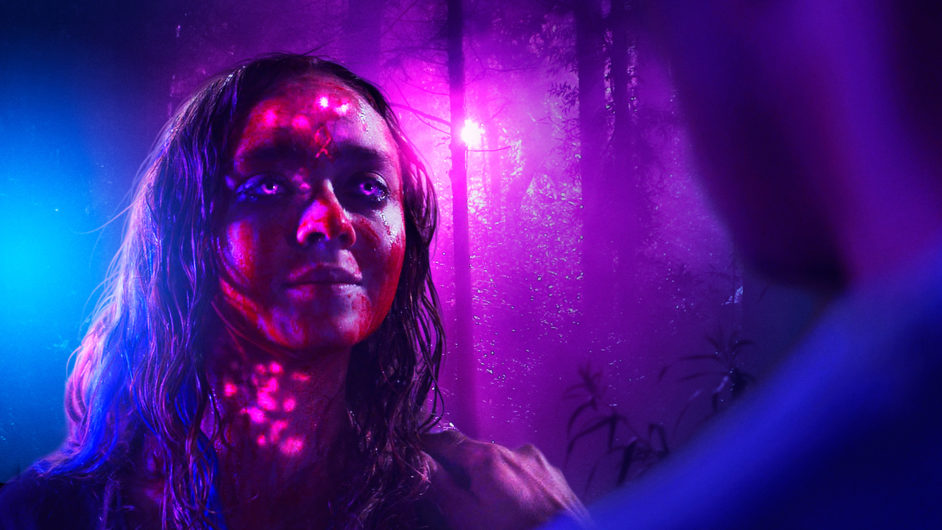
Let’s get one thing out of the way: the titular color out of space—intended in both the original story and vaguely mentioned in the movie to be indescribable, a hue humans cannot properly register and explain—is purple. Or, more accurately, shades of purple—from dark, menacing magenta to a violet so bright it almost hurts to look at. It’s a double-edged sword of the film medium, having to put to picture something that was intended to be created by and in a reader’s mind. However, in The Color out of Space, being able to put a name to that indescribable, mesmerizing, haunting color is not a disadvantage; you’re not worried about what the color is, but what it’s going to do. Because the color is not a static feature or even object in this Lovecraftian tale—it’s a force, a powerful force, with a strength alien and unknowable even as it seeps into your blood and takes hold of your mind.
A little background: The Color out of Space is a film adaptation of the 1927 short story by the Cthulhu creator and notorious racist himself, H.P. Lovecraft (side note: I don’t think it’s a coincidence that the stealth lead of this film, who also provides the opening and closing narration, is played by a black actor, Elliot Knight, who is excellent). TCooS did the film festival circuit in 2019, and received an extremely limited theatrical release before being released on Blu-ray/DVD and streaming platforms. My boyfriend and I had been keeping a close eye on the film ever since we saw the trailer in November 2019, and were very disappointed when there was only a single, one-night showing of the film in Milwaukee (which neither of us could attend). I bought the Blu-ray for his birthday, and we finally were able to watch it just yesterday—and by God, was it worth the wait.
The story focuses on a family of five—mother and father, two sons and a daughter—having semi-recently started their lives afresh on an isolated farm after the mother went through cancer treatments. They quickly encounter Ward, played by the aforementioned Elliot Knight, a hydrologist who becomes concerned with the water the family heedlessly consumes after a mysterious meteorite lands in their yard. Before you even start the movie, however, a certain expectation has been set—the poster, DVD cover, and trailer prominently feature Nicolas Cage, and this primes the audience to be ready for some quality, grade-A Nic Cage freakouts. The film definitely delivers, but what excited me more was less when Nic Cage was onscreen and more how he was used onscreen. Due to his enthusiasm in embracing his own meme quality, Cage can be tremendous amounts of fun in bad movies, but only up to a certain point. The best performances will wilt if they’re not supported by the story, script, surroundings, and other actors. Here, director Richard Stanely—who also wrote the screenplay with Scarlett Amaris—finds the sweet spot by balancing a very volatile element with a lot of potential—Nic Cage—with all of the other wonderful elements contained in The Color out of Space.
What The Color out of Space gets right that so many other Lovecraft film adaptations failed to do has little to do with the cosmic horrors, or the visuals (though TCooS does well with both), but with balance and pacing. There aren’t any wasted scenes in this film, no superfluous lines of dialogue, no plot cul-de-sacs or unnecessary diversions; but then when—to use a technical term—shit gets fucky, little is spared in creating a beautiful spectrum of terror, from delusions and hallucinations to gritty body horror, all set against a tense, moody score (reminiscent of the Uncut Gems score, all synthesizers and spacey sounds) and vivid, gorgeous visuals.
The film isn’t perfect (some of the setup is established in a blur with throwaway lines, the older brother doesn’t really get a character arc like his siblings, and my excitement over seeing Indigenous actress Q’orianka Kilcher on the cast list was diminished when she only appears briefly in three scenes), but these nitpicks are just slight distractions from the magnificent piece of art that is The Color out of Space. The film does so much right, showing restraint to make its punches hit all the harder, not being afraid to include humor amidst the horror, the spiritual and practical homage to Carpenter’s The Thing, the bizarrely wonderful and appropriate Trump impression Cage pulls out at strategic times. The film also acts as a triumphant comeback for director Richard Stanley, who had not directed a feature film since he was fired from his dream project, The Island of Dr. Moreau, in 1996. The Island of Dr. Moreau (which I watched as a teenager, deep in my Val Kilmer phase) was an absolute nightmare to make, for cast and crew, both before and after Stanley was fired (it’s a fascinating tale, and if you’re interested in cursed productions, check out the appropriately named documentary Lost Soul: The Doomed Journey of Richard Stanley’s Island of Dr. Moreau).
And with that, I arrive at a call to action; during promotion for The Color out of Space, Richard Stanley revealed that he wanted to make a whole trilogy of Lovecraft-inspired films, with TCooS being the first, then, God willing, followed up by one of Lovecraft’s most famous stories, The Dunwich Horror. Because TCooS was not given a wide release, the only way to support Stanley’s vision is by word-of-mouth, and buying/renting The Color out of Space. The prospect of another visceral, visually stunning feast of a Lovecraft movie is something to get very excited about, especially with Richard Stanley at the helm. Lovecraft’s works are public domain, so Stanley doesn’t have to deal with pressure from a studio that is very precious about its intellectual property, the way DC films have slashed and reshot entire movies trying to build a franchise (which, granted, they seem to have finally given up on), or how Marvel keeps its movies firmly within the safe, easily digestible formula audiences are used to. So, please, if you have any interest in The Color out of Space, definitely rent or buy it—it’s available on DVD and Blu-ray, and streaming to rent or buy on Amazon, YouTube, Google Play, and Vudu. The Color out of Space is very much a movie I crave after watching something mediocre (like last week’s In the Tall Grass)—it’s fresh, fun, fascinating, and most importantly—purple.
 Hyperfixation Film Reviews