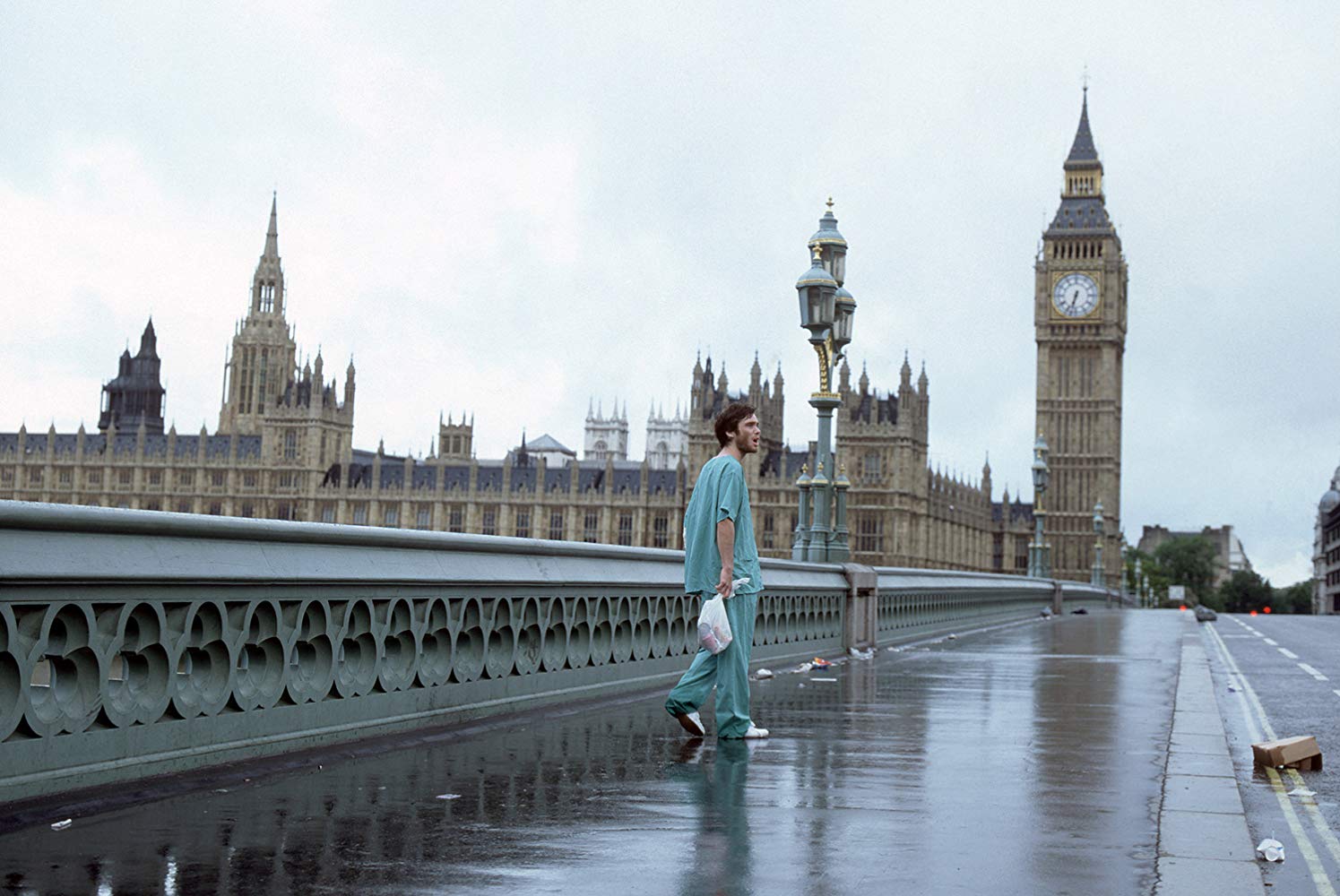
There is a moment in the 2002 film 28 Days Later where the main character Jim, who recently arrived at an army base with his friends seeking sanctuary and a cure from the rage virus, is told by Major Henry West, “I promised them women.” “Them” being the nine remaining soldiers he has at his command, West goes on to tell Jim that he had prevented one of the nine from taking his own life just a week ago; the soldier had been despondent at the ever-decreasing odds of life ever becoming normal or good again, when people with the rage virus were still swarming outside their heavily defended encampment and the entire city of Manchester, devoid of its pillars of infrastructure, was an endlessly burning pile of rubble. Major West tells Jim, “I promised them women,” meaning that, as he puts it, the only way to keep his soldier’s fragile stability and control in check was with the promise of new life—a rebuilding of society, a chance to once again feel secure and content. The Major’s magnanimous words ring rather hollow, however, when he allows his soldiers to begin sexually harassing and assaulting Jim’s friends, Selena and Hannah, the latter of which is only fifteen years old.
“I promised them women” is the single scariest moment for me in all of 28 Days Later, a film which is not without its fair share of somewhat standard frights; from sudden, silent attacks from swarms of infected people, to more existential horrors, like being faced with a child infected with the virus, relentlessly trying to harm and thus infect you, with the only choices presented being: succumb to infection, or kill this child. “I promised them women” is the tipping point of the film, where the tension that has been steadily ramping up in intensity for 60-plus minutes suddenly shatters with a terrible, inevitable finality; the quiet, steady notes of the best piece of scoring from the film, “In the House, In a Heartbeat,” starts to play, a reference to a statement from Selena to Jim, early in the film; paraphrased: if you become infected, I will kill you in a heartbeat. In the ensuing 30~ minutes, we see all the themes director Danny Boyle and writer Alex Garland have been laying the foundation for spotlighted against the unnervingly constant two-note pattern that begins in “In the House, In a Heartbeat”; themes of masculinity, and the importance of human connection and empathy.
The most obvious theme that plays throughout 28 Days Later is of friendship, love, and family—the important aspects of what bonds humans together. Jim wakes up after the rage virus has already swept throughout the country, naked and alone in a hospital room, the picture of vulnerability. He’s not only eager to join up with other survivors, but needs to in order to survive, a fact Jim never seems embarrassed or emasculated by. Father-daughter pair Frank and Hannah feel similarly to Jim, that there’s safety in numbers; the only exception is Selena, who we see murder her partner-in-survival, Mark, without hesitation after he’s bitten by the infected, just ten minutes after we’re introduced to her. Just after this brutal scene is when Selena tells Jim that she’d kill him in a heartbeat if he became infected, because the absolute top priority is staying alive—not saving people, not looking out for anybody else, just surviving. It would be very, very easy to have had Selena fall into a “badass bitch” stereotype, but it barely takes any time before we’re shown that Selena is far from heartless. As they travel together, Selena can tell Jim is struggling, but he doesn’t tell her he has a headache until she directly asks what’s wrong with him. When Selena asks why he didn’t mention it earlier, Jim bluntly states that he knew she wouldn’t care. Selena pauses for a brief but very telling moment before she pulls out some painkillers and tells Jim, in an almost gentle voice, how they can fix it. Selena’s tone is important because it lets us know that she isn’t offended by Jim’s assumption, just surprised; one could interpret that she regrets coming off as uncaring or cruel, and so makes an effort to adjust that. Seconds later, however, the pair are forced to suddenly sprint up several flights of stairs as the infected come for them, and Selena doesn’t slow down or even turn as Jim, who falls a floor or two behind almost immediately, desperately calls after her to wait for him. Several scenes later, after meeting Frank and Hannah, Selena warns Jim that the pair would just slow them down, and could get them killed. For that one moment of softness from Selena, it’s immediately followed up by two more instances of her singular and, one could argue, selfish mindset of survival. It’s a back-and-forth game that Selena plays throughout the entire movie, though by the end, when Selena is literally throwing herself between Hannah and the soldiers, it’s clear that she has given up her unforgiving “go it alone or die” attitude.
Selena never shows the same hesitation towards necessary violence that plagues Jim throughout the film—until almost the very last moment, when she’s confronted by a blood-drenched Jim, and halts her instincts screaming at her to kill kill he’s infected kill him. With Selena’s machete hovering just scant inches away from his neck, Jim says, tone suffused with both relief and sass, “That was longer than a heartbeat.” This is a culmination point for both characters: Jim standing strong and resolute in the decisions he’s made on his own, and Selena letting her humanity respond before her survival instinct does.
On the topic of masculinity: it doesn’t feel like accidental casting that Jim is played by Cillian Murphy, a somewhat odd-looking yet beautifully striking-looking man, whose slight build and musical accent puts viewers in mind of (and I hate to use this phrase) a “beta male” protagonist. Not somebody like Dwayne Johnson, whose enormous build backs up the easy-going confidence he often portrays onscreen, or even a leading man like Robert Downey Jr., whose quick sharp wit backs up a different kind of confidence that often results in cutting down those in front of him. Murphy’s Jim starts the film as vulnerable as possible, and is saved multiple times in the film by Selena and Frank. He knows nothing about the changes to the world, having been in a coma for the past 28 days, and frequently fucks up, forgetting the new rules he has to follow in order to survive. When he suggests checking out an apartment building with flashing lights to Selena, it isn’t with a tone of aggression or any kind of self-consciousness; just a calm, logical, and optimistic thought process. Jim’s defiance of the typical leading male character archetypes becomes much more obvious once he, Selena, and Hannah arrive at the makeshift army base; he stands in stark contrast to the Major and his soldiers, who by and large are loud, jeering, and full of restless machismo energy, which is demonstrated almost immediately after the group arrives, and some of the soldiers commandeer the Jeep(?) the group had been driving, doing doughnuts outside the fortified walls whilst hanging off the sides of the car, screaming and laughing. Jim is quiet in the face of all this—quieter than usual, as their arrival was immediately preceded by the awful and heart wrenching death of Frank, whom Jim had to kill himself—and responds with mostly bemusement at the Major’s aggressively dominatingly masculine words and actions. The Major immediately separates Jim from Selena and Hannah, assuming that Jim is the de facto leader, and ribs Jim about traveling with Those Women, to which Jim responds noncommittally. This is when the Major has the “I promised them women,” conversation with Jim, who seems too shocked to raise much protest, not that the Major seems to expect (or allow) any. After the Major finishes telling Jim that his friends are to be subjected to non-consensual sexual assault—for the sake of morale, you see—he leaves Jim with a fondly-delivered pet name and a hand ruffling his hair. Besides seeming vaguely irritated by the condescending treatment, Jim is at a loss of what to do, besides warning Selena and Hannah and getting all of them out of the reach of the Major and his soldiers. He doesn’t run back into the Major’s office, guns blazing, ready to mow him and his soldiers down; rather his instinct is to run, now. Unfortunately it’s too late, and Jim is escorted outside the fortress by two of the soldiers to be executed, along with another soldier who had the gall to object to Selena and Hannah being raped. Here, though, is the beginning of Jim’s rise: he manages to trick the soldiers, playing dead among the row of Infected bodies and leaving his ripped shirt on the barbed wire fence to suggest he escaped. Thunder booms loud and close as the climax of the third act begins, and we soon find Jim back at the fortress, shirtless and rain-soaked, almost totally silent as he begins to take out the soldiers, one by one. The old building and disorienting lightning flashes make Jim’s actions seem like that of a ghost, as the dwindling group of soldiers spread out to try and find him, jumping at shadows and swinging their rifles around to no avail. In these scenes are some of the most brutal acts of violence, as Jim unleashes the chained-up Infected soldier into the building to wreak havoc, and pushes his thumbs into the eye sockets of a soldier he’s fighting (a scene I have, with every single viewing, had to close my eyes at). During this entire lethal massacre, where he’s flitting from dark corner to shadowed hallway, Jim says nothing, his entire being silent—right up til Selena almost murders him, not sure if her blood-soaked friend is Infected.
In a different, more cynical reading, one could probably follow all the points I’ve laid out and complain that Jim’s progression from healthily scared, frozen prey to bloodied brutal predator is a cliched realization of the oft-used trope “underdog protagonist turns into improbably slick killing machine,” but I find 28 Days Later to be one of a few films that uses that trope correctly, by effectively establishing Jim’s abilities and fears, and slowly having him forced to confront and struggle through his barriers. Director Danny Boyle has, to great effect, established the power and lethality of absolute silence, with at least two scenes where we witness Infected sprinting rapidly yet soundlessly towards prey, only making noise as they burst through glass or clamp onto their target—and in both of those scenes, Jim was the target. The third time we see this action, it’s from Jim, turning the attacks he had suffered into a tool to make his enemies suffer. Jim’s strength in the third act is also not one of unbelievable, previously unseen muscle power, abilities, or weapons training, but of using skills he’d been forced to learn since he’d woken up alone in the hospital. And when Jim is shot, it’s not because he froze in a moment of choice paralysis, but simply because somebody else had the upper hand in the form of surprise. In the end coda, we can see that Jim has still retained his good humor, and hasn’t undergone a grimdark character overhaul; he’s still surviving, but finally thriving as well.
28 Days Later is far more interesting than it needed to be, and its relatable, engaging characters, interesting themes, and singular style are what sets it apart from more generic, throw-away zombie thrillers. What I like most about 28 Days Later is the subtlety of its strengths; while we’re with Jim and his point of view from the start of the film, Selena is arguably the co-lead of the film, and I love her so much. While she isn’t defined by her femininity, she also doesn’t reject it in order to appear more capable or serious; she’s cunning, assertive, can laugh and joke while still being focused, and she’s a natural badass without being cold-hearted. To wrap up, I highly recommend 28 Days Later, both as a character study and as a scary thriller. I even recommend its not-great-but-pretty-good sequel, 28 Weeks Later, and, God willing, you’ll hear from me the second a 28 Months Later gets made. It’s been thirteen years, sure, but it could happen. And I’ll be first in line to see it.
This didn’t fit into the essay, since I mostly focused on Selena and Jim, but I wanted to include it here because I love this scene so much:
One of the more touching moments in the film comes when, after a surprisingly pleasant scene wherein the gang raids a supermarket and come away with preservative-fresh apples (“Mmmm, radioactive,” Frank jokes), chocolate, and fine whisky, the four sleep in an open field. Finding difficulty in relaxing enough to sleep, Hannah and Jim take some of Selena’s Valium, with only Frank refusing. We then fall into a nightmare Jim is having, where he wakes up in the field completely alone, his friends gone, with no sign of them ever existing. In the dream, Jim is essentially re-enacting his first scene from the movie, only this time he’s screaming out his friend’s names, visibly distraught. Cutting back to the real world, we see Jim twitching and muttering in his drug-induced sleep, and Frank, still awake on watch, quietly nudges the younger man awake (“Jim, wake up—it’s only a dream, it’s alright, you’re alright.”). Jim rouses at Frank’s voice, half-asleep but no longer in the nightmare, and before he slips back under he murmurs, “Thanks, Dad.” Jim is asleep again instantly, but the scene holds for a few moments more, and we see Frank freeze at Jim’s words before quietly retreating back to his post. It’s a well-done moment, emphasizing Jim’s current state of mind and Frank’s role as Group Dad.
 Hyperfixation Film Reviews